Pages

Tuesday, December 13, 2011

Shared Thinking

I wrote most of this months ago...so finally thought I should share it with you all!

I don’t talk much about my studies here. That’s not because I don’t enjoy them. I do. I guess I am usually just so busy studying, that by the time I am done I don’t feel like talking about it all over again. But I was thinking about my Early Years Degree this morning, going over some of the concepts we’ve been discussing in our online forum group. And I had a bit of a revelation. Concepts that I am learning in class do not just apply to teachers! Duh. You think?! The learning we look for as teachers, we can also look for as parents. I know I do. I utilise the things I am learning in my Degree often in my interactions with my son.


So I thought there might be a few parents out there who would be interested in what we’ve been learning in class.

Namely, shared and sustained thinking. In essence, what we’re finding is that children learn in relationship. They can certainly make connections on their own, and often do so. But they learn best and most through relationships with other people and things. They need it.

Daddy and Munchkin involved in a favourite past-time: reading the machines book together! 
Shared and sustained thinking is all about building a relationship of conversation with a child. Not just a quick, “Hi, how are you?” and moving on. Sustained. Allowing a bit of time and space for children to express their thoughts (when you have limited language at your disposal it can sometimes take awhile to get an idea out, you know!). It’s about providing space for them to return to an earlier topic, sometimes again and again.

Shared. Not one-way, or one-sided. Not just listening to them babble and saying “Ah-ha, yup.” (I know, we all do it at times…a very useful strategy when you really have NO idea what they are trying to say!). Not just talking and talking, giving instructions, telling them what to do or how to think. Nope. Shared. Mutually beneficial and mutually enjoyable. Really trying to connect with what the child is thinking and connect them with what you are thinking.

Shared, sustained thinking.

We highly value play as a means of learning in the early years in New Zealand. I totally agree: freely chosen play is essential. Kids need space to be themselves. Play gives them that. They can create, imagine, imitate, negotiate, and relate all in a safe setting that they have some control over…their own games. But alongside this, and equally important I believe, is the need for us to come alongside them and share their thinking. This is what extends their learning, takes it to the next dimension. It is all too easy to tell the kids to “Go off and play,” to get them out of our hair. Who hasn’t done that? There are multitudes of things that need to be done, and limited time in which to do them. The kids will be happy playing for awhile. True. But sometimes they’d gain so much more from playing with you. From having a conversation with you. Asking those hairy questions and just thinking through some answers with you.

I've been guilty of sending Munchy off to play already, and he's only 18 months old.  "I'm cooking dinner, go and find your book."  "Mummy has to hang out the washing."  So now that I'm thinking about it, I'm trying to find ways of involving him more in what I'm doing, in talking with him even when we are engaged in separate tasks, and in expecting him to respond and want to be with me.  This does get messy.  I have discovered that a plastic mat under the chair at the kitchen bench is very useful.  And that I need to remember he can reach almost the entire way across the bench to whip a mixing bowl out from under my fingers!  And sometimes (okay, a lot of the time!) I find it really tediously SLOW.  Oh my goodness, I had no idea how much a toddler's involvement could slow you down. Everything takes twice as long, at least!  But we share together.  Sometimes we play.  Sometimes we work.  Sometimes we do both together.

The breadmaker died (it has since been fixed, thanks Dad!) so Munchy helped with the kneading.
So cute!  Although throwing the tin of screws all over the floor then trying to eat them wasn't so cute.  Sometimes I wonder why I involve my son.  Then I remember how important he looked helping hold that hinge, and I just have to let him help me again. 
Shared, sustained thinking is just that. It is us sharing with our kids. Sharing our thoughts. Sharing their thoughts. Talking. Questioning. Thinking. It's an incredibly powerful tool in building that special bond between us. And, as a bonus, this shared thinking allows us to more accurately see what is going on inside our beloved little one’s head. It’s exciting, getting to share in new discoveries every day!

Cool playdough creations.  I just LOVE playdough!

This is what I wrote in class about shared thinking (remember, from the perspective of an early childhood teacher):

"I believe that in order for this sustained thinking to take place, I must actually BE INVOLVED in children's activities and games, not just a static observer. I like the idea of sustained themes being present for children, perhaps an area of the kindergarten set up that has things collected from last week's field trip, with new library books strategically added, a microscope, some paper, glue, pens, etc for any creating...children can then return to this as they please, teachers can add things to it as children and teachers come up with new angles on things they want to find out or do. (edited: this applies at home too – you could put the takeaway containers from last night’s dinner on the table, with chopsticks and menus and see what happens – you might end up invited to a restaurant for lunch, you might be asked why the containers aren’t coloured, the possibilities are endless!)

Talking with a child about what they are doing, why, what they are getting out of the activity. Adding a new thought, perhaps just one. I do this with my son. His favourite games involve spinning things or rolling things. So we frequently find him with the lid from a jar on his little table, trying to make it spin around. I have often done things like, "What if we try it up this way?" or given him a different object to try spinning, or spun something myself without even saying anything to him. Just extending on the activity he is already engaged in, using some language around it "round and round," enjoying his enjoyment, and sharing in it with him. By starting this now, we are already opening a dialogue that will continue as he grows."

This shared thinking doesn’t mean you have to be constantly involved. You can still pop in and out of games at times, while sorting the washing or tidying the bench. Shared thinking can take place even when we are involved in different activities. Munchkin plays around my feet while I am making soup in the kitchen. I talk to him while we are both busy doing our own thing. “What have you got there, can Mummy have a look?” He hands it to me. I comment on it and hand it back, and return to cutting carrots. I tell him about what is going in the soup. He might be too young still to understand all the words, but he will be taking it all in subconsciously, learning the rhythms and nuances of our language. We are engaging in a form of shared thought, even though we are involved in different activities!

What do you do when you are honestly too sick to move and yet have to look after a small boy (and it's raining!)?!  Set up water on the kitchen floor of course.  And watch from your armchair, hoping he heeds the instructions to 'keep it in the kitchen!'

So for all you parents, grandparents, extended family, friends and teachers out there: Have a meaningful conversation with a child today. Stop. Listen. Engage.  Pass on your knowledge.  Relive some of your youth.
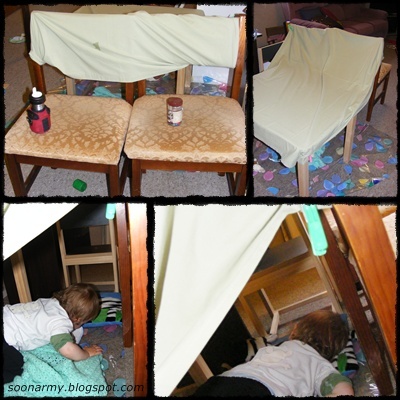
I am passing on my tent-making skills to my son.  My own mother taught me well.  Tent making is an excellent diversion on a wet day, provided you aren't too fussy about your lounge for a few hours!

Then can you come back and share your secrets with me?  I'd love to know how you engage with your kids, your tips and tricks for meaningful conversation.

Amy

Meet my Oxen

There's this funny little verse in Proverbs that I came across awhile ago.  I just keep coming back to it, and wondering what it means!

"Where no oxen are, the grain crib is empty, but much increase [of crops] comes by the strength of the ox." Proverbs 14:4 (amplified version)

So, I've thought and thought (and prayed some) about it, wondering what connection it has to my life. To my gasoline powered, electric lighted, supermarket shopping life.  Anyone know someone with an ox or two?  Nope, not me.  At least not personally.  My sponsored kids might, I guess.  Maybe.  They'd be lucky, anyone with an ox I imagine.  So, what are oxen, what do they do, and why do they increase crops?

My theory is that oxen work the soil.  They prepare for planting.  You can plant without them, but I imagine planting a paddock (field) of maize or barley might be just a tad difficult if you had to plough it all yourself.  Hard work.  Very, very hard work.  I imagine it might take too long and that you'd struggle to get the soil friable enough for seed to germinate and grow well.  I have no proof of this, of course.  I'm just imagining.  Oxen pull a plough.  So my theory is that if you own an oxen or two, you are able to plough a much larger area than you could do by yourself.  Heck, I imagine an oxen drawn plough would do more work than an entire family of strapping young men out there shovelling dirt!

So now that I've thought about what oxen are and what they are for, I'm wondering what I have in my life that could equate to an ox.  My breadmaker perhaps?  Considering I'd otherwise have to knead bread by hand which means I just never would, maybe!?

Then I realised, I do have oxen.  I have three.  Only they are a bit smaller than a real ox.  But then, our garden isn't exactly huge either.  My chookies are my oxen.  They till the soil for me.  They also eat scraps, poop lots, and improve the soil fertility.  And I don't have to stand behind a big baulky plough encouraging them to do so (like I imagine you do with oxen!).  I just give them greens, grain, water and some hay or wood shavings, and they do the rest.  Oh, and the occassional cockroach, leftover fruit, or worms from the compost bins also goes down well.  They like that.  They are three very happy chookies when I come calling!

What I theorise is that crops do not grow well of their own accord.  You have to prepare an ideal environment.  My chickens are helping do that, with as little direct effort from me as possible (plus, I get the bonus of fresh eggs in a few months time!  Beat that!!!).  I think that EVERY backyard suburban gardener should have a chicken tractor on their vege garden.  I know, I know, I am biased.  I LOVE chooks.  But seriously, they are amazing animals!  And don't go telling me you don't have room.  There are always bantams.  You might not get a tonne of eggs, but they still dig and poop enough for your lettuces and beans to be pleased you have them.

So, meet my (recently named!) oxen:


Autumn.  My mother-in-law's idea.  So named because her feather colour reminds me of autumn leaves.  Rusty red and tan.  Only this Autumn is fluffy too!


Ember.  You can't tell in this picture, but Ember's eyes are an amazing golden yellow.  Like embers.  Beautiful.


Tui.  After discarding all manner of names related to black things, I had an epiphany.  This little black hen isn't really black at all.  Her feathers shimmer and shine with hues of blue and green.  So I named her after the shimmery shine of a tui's feathers.  Black and green and blue.  Just gorgeous.

Ah.  It feels good to have finally given my girls names.  They have grown so much since these photos were taken!  It is just rather tricky getting pictures of them, they hardly ever stand still long enough (plus there is the small matter of the toddling boy trying to throw oranges, eat strawberries, and play in the birdbath!).

So, do you have any oxen in your life?  What do you think this proverb means?
Amy

Wednesday, December 7, 2011

This is NOT a Hobby!

Our vegetable garden is not a hobby!


Pruning roses, maybe.  Planting petunias, perhaps.  But growing vegetables, that is a household chore.  At least in my mind, it is.  My husband doesn't really agree.  He seems to think it is a nice little hobby for Amy to wander out and spend an hour (or so) in the garden weeding, digging, squashing, planting, and harvesting.  The thing is, he shares in the provision.  While sitting on his bum.  Now, don't get me wrong, Boyo does plenty of other things around the house.  But he hates gardening!  So it always ends up that I do it in my 'spare' time, which of course then means I don't actually ever HAVE any spare time.


I think the vegetable garden should be a chore.  Equal with washing laundry, doing dishes, vacuuming, and mowing the lawns.  It provides amazing food for us, which none of those other occupations can claim, so why is it relegated to a lesser position?!  It might be different if we didn't need the food, if I did just do it because I love it.  But I don't love weeding.  Really.  Who does?  I would rather knit.  Or read a book.  Or just sit and eat cherry tomatoes straight off the vine!  Our garden provides us with wholesome, cheap food.

The vege garden is also a household expense (yes, it has a designated amount put aside for it every month now!).  I've been really slack with this in the past.  I'd somehow expect my garden to produce bountiful food, but without me spending a cent on it.  The soil was terrible, I had no support for climbing plants, and I didn't keep up with the weeding.  It went to rack and ruin, and I wondered why I only got three beans off my bean plant before it shrivelled up and died. 


What I've realised is that if you want to produce a harvest, you need to prepare the soil.  Most important.  Boring, yes.  Tedious, yup.  But necessary.


So this time round I am investing some time and money into our vegetable garden, and I think the results speak for themselves.  I've not put much in really, just a bit of mineral and organic fertiliser, some hay mulch and some stakes (banged in by Boyo).  Boyo and I now have a (tentative!) arrangement that he will do more housework rather than helping in the garden.  He is happier doing that but I'm also happier as I feel like we are giving the garden the value it deserves.  Hopefully that will free up a little more time for me to maximise the provision our vegetables give!


Amy

Tuesday, December 6, 2011

Knitting Up a Storm (#21 and 22)!

Two more squares completed!  A lovely deep brown wool this time.  One patterned, and one random.


And in between I've been crocheting.  I'm trying to be a bit clever with this one, and crochet from the centre outwards as I knit bundles of squares, and have to start or stop my row of crocheting as little as possible (which is why it is this funny flower shape at present!)!  Muchkin was as interested as ever in the rows of stitching!


Amy

Thursday, December 1, 2011

A Tapestry of Colour


What is this chaotic jumble of coloured stripes?  A blanket, of course!  Or at least the beginnings of one.

This is what it might look like (if I don't change my mind):


And here are squares 18, 19, and 20!


With a bit more work left yet to do.


Never fear, nothing my trusty needle and a few minutes won't fix!  Ah, the pleasure of a quiet moment with my knitting.  Bliss.


Amy

It's Not All Hard Work

Just when I start thinking that gardening is feeling a little too much like hard work, all weeding, weeding, weeding, I am reminded that it's also beautiful.

Very beautiful.


Amy

Tuesday, November 29, 2011

Chook Cottage and It's New Residents

The chook cage is finally finished, the chooks in residence...they have been for several weeks but between being sick, tired, finishing study, and starting a new job, I realised tonight that I have yet to introduce you to my 'girls' or their new abode. 

So let's start at the beginning:

Two days before we were due to collect our chickens, I finished their cage.  My amazing Dad came and picked it up with his truck.  Boyo helped.  Munchkin and I supervised.  It was all very exciting!  Carried down our drive, hoisted onto the truck, it's pristine white glimmering in the sun, it looked fit for a queen!  Or three!


Transporting the finished cage to it's new home!

On the garden bed, ready for the chickens!

On Saturday, November 5th, we went and picked up our chooks.  A few folks were rather surprised that we went all the way to Ngatea to get them.  That's an hour and a half from Tauranga.  But the thing is, while we have breeders locally, I couldn't find someone with the birds I wanted, and the level of knowledge that would inspire me to the belief that the birds I got would indeed exhibit characteristics of their breed.  Plus we just decided to turn it into a fun outing (we being Mum and I). 

So many chicks!

Precious Poultry is the place we went to.  They have such a lot of different breeds and it was fascinating talking with the breeder there about chooks, genetics, and egg laying.  I now know that the biggest issue with backyard chooks not laying well is overfeeding, particularly when they are just coming into lay!  Fat chookies equal lazy layers!  Not that you'd know they are fat, as chooks are amazing at only eating what they need, but none the less we are meant to go a bit lean on the food early in their laying lives if we want good eggs.  Which we do.  Also, if you want good gene characteristics, such as egg laying, then the male line is as important as the female.  So you might hatch from a good layer, but not get good laying pullets because their dad's mum (so their paternal grandma!) was not a good layer.  Dad needs an egg-o-matic mother too!  All really fascinating stuff.
Bantam Sussex - aren't they gorgeous!?

I found another breed I want to get.  They are Bantam Sussex.  All the markings from a Sussex but tiny in comparison.  I loved my Sussex but they sure ate a lot and didn't produce many eggs.  These little girls apparently produce around 180 eggs a year.  Not a lot, but not too bad.  I'm hoping for 200-250 a year from mine.  But the trick here is that these little ladies only eat about 50g of feed per day and produce a size 6 egg.  Most egg laying chooks will eat 100-130g per day.  And a size 6 egg is really quite reasonable, not a piddling little bantam egg by any means.  I have had to admit to my husband that I am obsessed with chooks.  Not that he didn't already realise.

Here are my girls when we finally got them settled into their new house (after realising that at 6weeks old they weren't quite up to perching on the roosts and finding a few available boxes to shelter them!).  We were worried about the little brown one, she didn't travel so well, but picked up the following afternoon and has been perky ever since.


Barnevelder on left, black Australorp on right, meant-to-be-New-Hampshire-Red but probably isn't in the front!

Here are my parent's three, though not a good photo sorry (they are a little bit skitish, especially when a small boy keeps banging on their cage!).

Three New Hampshire Reds looking very tiny in their new home - see how rusty red their feathers are?  My one is more tan than rusty red, and is much bigger than they are too!

The chickens have all settled in well.  So far, the New Hampshires seem a bit more skitish than my lot, and also eat less.  My Barnevelder is the friendliest of the lot, especially if you happen to be carrying green things for her to eat!  They all had a lovely meal of worm-farm worms the other day.  It was rather amusing watching the antics of baby chickens trying to work out how to get wriggling worms in small, unskilled beaks!  All the chookies are now roosting on their own.  The New Hampshires had to be 'put to bed' every night for a couple of weeks as they originally insisted in sleeping in the dirt in the corner of their cage.  Outside.  The rungs on my cage's ladder are already falling off everywhere so I will need to fix that.  Grr.  Just when I thought all the work was over. 

At eight weeks old - two weeks after we got them!

They are growing so fast, some days I could swear they grew overnight!  Loving having chooks again, I do miss having them at my house (they are on the Big Garden at my parents) but I feel really blessed to have them.  Munchkin already knows how to feed them.  Although he does insist on holding one small piece of grain at a time, and dropping it through the wire on the side of the cage.  Adorable.

So, any ideas for names?  My last chooks were named for flowers: Mayberry, Rose, Pollyanthus, and Primula.  Haven't thought of any for these ones yet.

Amy